I neglected to note here that I recently co-authored a brief article the persecution of homosexuals at the University of Southern Mississippi during the late 1950s and early 1960s with my colleague Douglas Bristol. Douglas has also just begun a new blog documenting the lives of LGBTQ Mississippians, which is currently seeking contributors. Check it out!
Blog
Historicism and Erasure
I’ve recently come across a couple of blog posts on the problems of “erasure” in modern queer historiography, focusing particularly on that of lesbians and transgender individuals. In the first, Rachel Hope Cleves describes the recent “Gay American History @ 40” conference in celebration of Jonathan Ned Katz’s Gay American History (1976), with an emphasis on an apparently quite fraught debate on lesbian identity, both historically and politically. In the second, Cheryl Morgan responds by emphasizing how the very debates over lesbianism can — sometimes purposefully — erase the historical existence of trans identity in turn. While some lesbian activists fear the elimination of their historical identity in the wake of trans, some trans activists argue that radical feminists and lesbians are trying to undo their own. This debate is obviously longstanding and I wasn’t driven to write a brief post by intervening in it. Rather, I found both responses to be good for thinking about my own approach to the historicization of sexuality and the ways in which I think it necessary to take the complexities of these debates and apply them to supposedly more “stable” or “dominant” subjects, in particular the study of male same-sex sexual activity in the past.
In her post, Cleves describes an “aggressive form of historicism directed by academics at the category of lesbians” that has not, she implies, really been applied to male homosexuality. If we have constantly and consistently asked whether women who lived with other women in the past were “actually” lesbians, we have have not seemed to have much trouble assuming the sexual nature of men who shared their bed with other men. While Cleves may be right to point out that these questions were initially raised as a way of “dismiss[ing]…the importance of women’s lives, lesbians’ lives, and trans lives too,” I think that rather than rejecting them, we should apply them to precisely those subjects of history we think we already know. What if, in other words, evidence of male same-sex sexual activity was not, ipso facto, evidence of male homosexuality or even its precursors? It is precisely historical work on women’s sexual relationships that has prodded my own critical approach to the existence of male homosexuality in the recent past (for example, Sharon Marcus’s Between Women and Laura Doan’s Disturbing Practices). In some ways this claim seems obvious in the wake of the debates over social construction, but it seems to me that it is not taken as seriously by scholars of men’s sexual relations as it should be. The “aggressive form of historicism” levied at lesbians should, in other words, be also directed at gay men.
This approach contrasts with Morgan’s call to recognize the existence of trans identity in the past. Both Morgan and Cleves recognize the ongoing desire of marginal sexual subjects to have a recognizable history and as Morgan points out “there is massive of evidence of people having cross-gender and third-gender identities in history, and even of medical intervention.” That evidence, however, does not by itself mean that trans identity itself existed prior to the twentieth century. Transgender identity itself is not a singular thing, but just as with other gender and sexual configurations — including heterosexuality and cis-identity (itself a creation in some measure of the emergence of trans) — relies on a specific social and cultural relationship attributable not just to modern science and medicine, but to broader discourses about the body, the individual, and desire. In any case, I would argue that the kind of historicization that some see as erasing certain forms of identity actually acknowledges a past that acknowledges the complexities of sexual identity. Perhaps there is no transhistorical trans subject to look for in the past (just as there is no lesbian or gay male one either), but there is a trans history, comprised of the multiple forms of cross-gender identification that existed in the past, ones that intersected uneasily as well with other kinds of sexual dissidence, such as same-sex sexual desire.
Resisting the stability of the sexual past, therefore, seems necessary to achieve the “opening [of] the past” that Cleves calls for at the end of her piece. Questioning rather than assuming the existence of our own identities in the past highlights other kinds of relationships that may have existed. The very kind of historicization deemed suspect in this debate may be precisely the tool we need to revitalize the connections that cross contemporary identity categories. In other words, breaking down contemporary modes of being or refusing to approach the past only to confirm those identities, may be precisely what is necessary to showcase the connections we have lost in the wake of modern sexual politics that always seems so ready to put us back into self-contained boxes.
Metaphors of Slavery
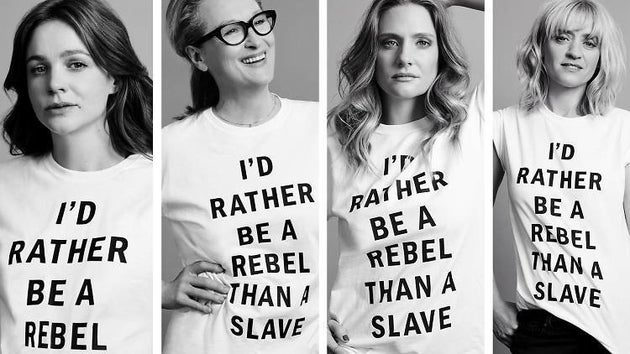
It’s fairly rare that I feel that I have something to contribute to a controversy du jour, but I do think that something key is missing in the ongoing discussion of Meryl Streep promoting her new movie by wearing a shirt with an Emmaline Pankhurst quotation that reads “I’d rather be a rebel than a slave.” I admit that when I first saw the images, I did not know the origin of the quote and was, quite frankly, shocked. I immediately slotted the saying right into my current geographic context where a “rebel” has a certain Confederate connotation and “slave” an obviously real, living history. Knowing the quote’s origin only changes the degree to which I think its problematic, however. And no, the full quote doesn’t solve the problem:
Know that women, once convinced that they are doing what is right, that their rebellion is just, will go on, no matter what the difficulties, no matter what the dangers, so long as there is a woman alive to hold up the flag of rebellion. I would rather be a rebel than a slave.
Time Out has defended the shirts by arguing that “The original quote was intended to rouse women to stand up against oppression – it is a rallying cry, and absolutely not intended to criticise those who have no choice but to submit to oppression, or to reference the Confederacy, as some people who saw the quote and photo out of context have surmised.” This defense not only fundamentally misunderstands the relationship between turn-of-the-century white feminists and questions of slavery and race, but also ignores the way that this metaphor has been historically deployed in the first place. The problem is not simply what the words mean now, but what they meant then.
Since at least the eighteenth century, people have used the metaphor of slavery to make claims for a set of political rights even as they ignored the ways race shaped the bodily politic for whom they claimed to speak. Political liberalism itself came out of resistance to people’s “enslavement” to the “tyranny” of monarchy even as it often refused to reckon with slavery itself. As Michel-Rolph Trouillot pointed out in Silencing the Past (1995),
‘Slavery’ was at that time [during the Enlightenment] an easy metaphor, accessible to a large public who knew that the word stood for a number of evils except perhaps the evil of itself. Slavery in the parlance of the philosophers could be whatever was wrong with European rule in Europe and elsewhere. To wit, the same Diderot applauded U.S. revolutionaries for having ‘burned their chains,’ for having ‘refused slavery.’ Never mind that some of them owned slaves. The Marseillaise was also a cry against ‘slavery.’ Mulatto slave owners from the Caribbean told the French Assembly that their status as second-class free men was equivalent to slavery. This metaphorical usage permeated the discourse of various nascent disciplines form philosophy to political economy up to Marx and beyond (85-86).
Trouillot places this usage in the context of the silencing of the Haitian Revolution, but it has a broader effect of erasing the particularities of racial hierarchy, violence, and domination in order to effectively produce a liberal subject that was by default white. Even as the anti-slave trade movement gathered speed, few made the claim that former-slaves deserved full equality or belonged to the same rung of humanity as Europeans. When Pankhurst argues that women were slaves and had to choose to “rebel,” she effaces the history of slavery and imperialism as well as the history of anti-slavery and anti-imperialism in order to advocate for her own admittance to a polity that was, by definition, premised on white supremacy. It makes the claim for gender equality at the expense of racial equality because if upper-class white British women were “slaves,” then what do we call those who actually were? The call to “rebel” in this context is premised on, not incidental to, an assumption about who deserves rights and who does not.
Pankhurst herself, it is worth pointing out, was a fierce advocate of the British Empire. But, then again, is anyone surprised that the promotional tour for a movie about the suffrage movement, written by someone who “didn’t want to make a feminist film” (despite the linked interview making pretty clear that she herself considers herself a feminist) and starring someone who refuses to call herself a feminist, would be clueless about this?
Article in the Journal of the History of Sexuality
I’m very pleased to announce that I have an article in the most recent issue of the Journal of the History of Sexuality titled “Serving Sex: Playing with Prostitution in the Brasseries à femmes of Late Nineteenth-Century Paris.” The article traces the emergence of “brasseries à femmes” — cafés that featured serving girls — as a target of moral disapproval in late nineteenth-century Paris. In particular, the servers were often accused of being prostitutes, an assumption that has also pervaded a good deal of historical work on them. I argue, however, that we shouldn’t take this association at face value. Rather, I follow art historians and literary critics who have shown that representations of serving girls emphasized their essential ambiguity: were they or weren’t they available for sex? [1] Using records drawn from the Archives de la Préfecture de Police alongside published moral commentary, I show that this ambiguity was not just an effect of male discourse, but was also a key strategy of the servers themselves. The servers were able to use the assumption that they were prostitutes to their advantage as they manipulated their customers into believing that they were available for sex, whether they actually were or not. Even as the association of serving with prostitution constrained these women, therefore, it also offered them a limited ability to shape their day-to-day lives.
[1]See for example Hollis Clayson, Painted Love: Prostitution in French Art of the Impressionist Era (New Haven: Yale University Press, 1991); Theresa Ann Gronberg, “Femmes de Brasserie,” Art History 7, no. 3 (1984): 336; Jessica Tanner, “Turning Tricks, Turning the Tables: Plotting the Brasserie à Femmes in Tabarant’s Virus d’amour,” Nineteenth-Century French Studies 41, nos. 3-4 (2013): 256.
On Privilege
Class is canceled tomorrow (not for President’s day, mind, but for Mardi Gras) and I thought, after reading an interesting piece on privilege by Belle Waring at Crooked Timber, I may use some of the extra time to write a proper blog post. The post itself serves as an invitation for her — unusually respectful — commentators to continue discussing the broader issues raised by the recent post — comment really — by Scott Aaronson on the relationship between male nerd culture and feminism. The gist of the matter is that some men feel that their status on the bottom of the masculine totem pole is evidence of their lack of “privilege” and feminism either a) is the cause of that problem or, more gently, b) hasn’t done enough to address it (Susan Bordo
My desire to post on this was not about the whole issue, but rather to just try to lay out a couple of the more annoying misconceptions about what “privilege” means when its used in feminist, queer, and other minority discourses. I admit, however, that I rarely use the term myself when I teach, mostly because when I used to throw it around in my college years, it became a catch-all explanation for the operation of power. Rather than offering an analytical lens privilege became a cudgel, a self-evident explanation for all sorts of social relationships that are often much more complicated. I actually think that some of the problems people have in understanding the use of the term is related to this issue. When folks hear “male privilege” they understand that to mean “privilege defines masculinity,” when in fact there are all kinds of masculinities that operate in contemporary life, some of which are more privileged than others.
Anyway, there was a comment in Belle’s thread that got me thinking on these lines. Here’s the second half:
The idea that, when I encounter a daughter of wealth, who never had to deal with beatings, that I, the son of a blue collar worker, who picked radishes next to migrant workers as a teen, am the ‘privileged’ one, strikes me as more than a little hilarious.
Look, people are individuals, with individual circumstances, and life stories, and this business of assigning ‘privilege’ to entire genders or races, in complete disregard of those individual details, isn’t just nonsense. It’s destructive nonsense. Real life isn’t lived on the basis of nominal ‘privilege’ and ‘up/down’ relations that exist only in theory.
Real life is lived in the fine grain, where the daughter of Ivy league parents goes to college, meets the first son of Appalachian farmers to make it past K-12, and imagines she’s confronting an embodiment of the “patriarchy”, rather than a prole struggling to better himself.
Less assigning power relationships, people, and more observing what’s really there. You’re not living in feminist theory, you’re living in a world that isn’t constrained by it. Don’t let the theory blind you to what’s really around you.
Some thoughts:
1) Privilege is not all or nothing. Having one form of privilege does not mean that you won’t experience forms of oppression, nor does it mean that others who experience forms of oppression won’t also have privilege. This is because we all take on, act out, and are multiple identities. Our relationship to others and to the social world are shaped by the way those identities “intersect.”
2) Privilege cannot be measured by the oppression olympics. (I’ve really returned to college with this post). Measuring whether the “daughter of wealth” has more or less privilege than you is a fruitless endeavor because privilege isn’t something one simply “has” as a static effect written on your body or identity. Rather, it is something that “operates” in particular situations; it therefore cannot be quantified. In other words, at certain moments you may suffer because of who you are and how you present (yes, that sucks!), but at others, you benefit (go, you!). (I’m struck by the way these arguments are essentially different ways of saying that “everything bad that happens is someone else’s fault, everything good that happens is due to my own accomplishments.”)
3) Privilege is not simply about the individual, individual circumstances, or life stories (another word for “anecdote”). Privilege is about structural benefits that accrue to people on the basis of their perceived or actual gender or gender identity, race, bodily shape, sexual orientation, etc. The emphasis on the individual are attempts to sideswipe the implications of the social structures of which we are a part and are of a piece with neoliberal emphases on “choice” as a substitute for freedom. The illusion that it is simply individual circumstance that defines one’s relation to others and to success. And this illusion that makes it harder to wrestle with the broader constraints we all face. We cannot simply “choose” to disown our privilege.
4) Privilege, therefore, is not something one can analyze simply by looking “to what’s really around you,” because we all act in a world that is designed to hide it away. This is partly what “cultural hegemony” means; the creation of a worldview for and by the powerful that becomes so dominant that one must struggle to recognize it as anything but the common sense of the day. Feminist theory in part tries to reveal the constructed nature of that worldview in order to better challenge it. It is therefore one of the things that can enable you to see “what’s really there.” Don’t make the mistake of reinforcing a false dichotomy between “theory” and “reality.”
Ultimately, a lot of these issues can be boiled down to a lack of basic empathy for others (“society”) and an over-indulgence on oneself (“the individual”). In this way, it’s similar to the anti-vaccine doctor who doesn’t care if his “personal choice” harms another child. The inability to put oneself in another’s shoes, the total faith that one’s one feelings must be the only possible explanation, the only possible legitimate way to feel, has made understanding about how we impact others, how we — despite ourself sometimes — contribute to inequality, incredibly difficult. The most shocking moment of Aaronson’s comment for me, in this regard, was when he said that “My recurring fantasy, through this period, was to have been born a woman, or a gay man, or best of all, completely asexual, so that I could simply devote my life to math, like my hero Paul Erdös did.” This statement not only shows a complete inability to comprehend what it means to be a woman, a gay man, or an asexual person in contemporary society, but also a complete unwillingness to try. Had he done so, he may have been able to recognize that feminism actually has identified one of the causes of his problems. It’s called patriarchy.
Edited for some grammatical mistakes.
Syllabi for Spring 2015
While I haven’t had time to blog since starting my new job at Southern Miss, I have continued to get periodic e-mails from folks who find the syllabi I’ve posted online, so I want to continue that tradition. Next semester, I’m teaching an honors section of World Civilizations Since 1500 and a Senior Seminar. I recognize that my World Civ syllabus is very much European oriented, but an emphasis on empire allows me to talk about other regions of the world at the same time. My senior seminar is a version of a course I introduced at Kenyon College and uses the theme “History and the Popular” to guide students through the process of crafting original research. Links to both syllabi are accessible in the menu above.
Changes
I’m extremely fortunate to be starting a new position at the University of Southern Mississippi this fall as an Assistant Professor of History. I’m taking the opportunity to begin thinking about how I use this site a bit differently regarding my teaching. The past two years I used it in lieu of traditional course manage systems. Sometimes, this meant requiring students to use WordPress to blog their reading responses. In other instances, I used the site to display final projects. While I may continue, in some manner, this latter use, generally speaking the use of my own system for weekly student assignments just created more work for all involved. Instead, I will be shifting to the course management system used at Southern Miss.
In addition, while I will continue to make my PowerPoint slides available to my students after each lecture, will leave the slides from past courses online, and am happy to send links to new slides to anyone so interested, I will not be making them immediately public each semester. These too will now be uploaded onto Blackboard. This decision is mainly because I want new students to encounter the slides in class, rather than seeing old versions online and figuring out an effective archiving system using WordPress seemed to be more effort than it is worth. Current and past syllabi will continue to be posted each semester, but they will only be connected to a separate course website in cases where I use the site for a final project.
I still want to make as much of my teaching materials public as possible, without sacrificing the in-class experience. I’ve been very happy to have been contacted by a few people interested in those materials after coming across them here and I hope that will continue. Don’t hesitate to get in touch at  if that is you.
The History of Sexuality in Video Games
I’m looking forward to when academic discourse begins to catch up with ongoing discussions online regarding representations of gender and sexuality in video games and other geeky ephemera. Today in the genre is a short history of sex in video games by Cara Ellison in Vice. I think it focuses a bit too much on the explicitly sexual and thus misses some examples that aren’t meant to be titillating. The most obvious is Atlus’s Catherine, which explores desire and infidelity in the context of — because why not — a puzzle game. But otherwise, it’s a fun read that also gives some nice nods to the way the medium has grown and matured over the past few decades.
Conservative politics will have conservative results
I’m not infrequently asked why I think that gay marriage support has basically reached takeoff velocity in the past couple years. My ordinary response is obliquely related to what I’ve been talking about in my past couple posts; it’s largely the effect of more and more people coming out of the closet. The cumulative effect of these individual acts simply reveals first, the ordinariness of gay people and second, their prevalence. The regional differences I’ve noted are obviously important, but for the most part people have gotten used to the fact that queers are here and they’ve gotten used to it. Joan Walsh, however, points to why gay marriage demands have, in the grand scheme of things, been relatively easily been accommodated: its politics are essentially conservative:
I’ve come to believe that the difference exists because, except for far right religious extremists and outright homophobes, marriage equality is, at heart, a conservative demand – letting gays and lesbians settle down and start families and have mortgages just like the rest of us will contribute to the stability of families and society.
As she acknowledges, this echoes a long-standing and ultimately successful argument in favor of gay marriage by the likes of Andrew Sullivan and more recently Ted Olsen. But Walsh also puts this trend into dialog with more troubling developments regarding women’s rights. While we’ve seen the onward march of gay rights, feminist accomplishments are being rolled back.
Walsh tries to avoid putting LGBT accomplishments into conflict with women’s rights (“I don’t mean to pit women against the LGBT community, or suggest one side is “winning” at the expense of the other), but its actually a bit hard to do. If the movement, as represented by mainstream organizations like the Human Rights Campaign, has deployed an essentially conservative vision of the family, then should we not recognize the possibility that it has, in fact, contributed to the solidification of opposition to forms of sexuality outside it? Gay marriage advocates have very effectively normalized gay partnerships, but in doing so they’ve also normalized the family itself and so have perhaps contributed to the resistance to a politics dedicated to increasing not just women’s, but everyone’s sexual autonomy outside those confines.
Content Warning: “Homosexual Wedding”

Today, I came across another article related to my continuing interest with people who apparently don’t know any gay people. This one is from a town in Pennsylvania whose high school has canceled a performance of Spamalot because there’s apparently a same-sex marriage. I’ll take the principal’s word on that, but the local news article, while largely sympathetic to those protesting the move, seemed to only reinforce the school’s claim that “homosexuality does not exist in a conservative community such as South Williamsport” with its reference to a “homosexual wedding” as if its some odd foreign custom, rather than an act that has been legal in Pennsylvania for a couple months now.
Evidence, however, apparently exists that homosexuality does, in fact, exist in South Williamsport: “I’d just seen one of my friends walk with her girlfriend the other day. It’s definitely in my school and all around,” said Gianna Goegard, a student from South Williamsport. I love this. Goegard had “seen” one of her friends walking with her girlfriend. Did her friend not introduce the two of them? Had the friend told Goegard that she was gay? Did they ever talk about girlfriends and boyfriends? Did those gay people who were “all around” reveal themselves? Its a quick quote, to be sure, but Goegard seems to be making an assumption, rather than speaking on the basis of actual knowledge.
Even in its attempt to poke at the principal’s assertion that there were no “homosexuals” in South Williamsport, the article enforces that very view by raising evidence that relies on the closet itself. In other words, even the attempt to reveal the existence of homosexuality in a “conservative community such as South Williamsport” relies on enforcing homosexuality’s otherness by virtue of its continuing status as the “secret which always gives itself away” (David Halperin, Saint Foucault