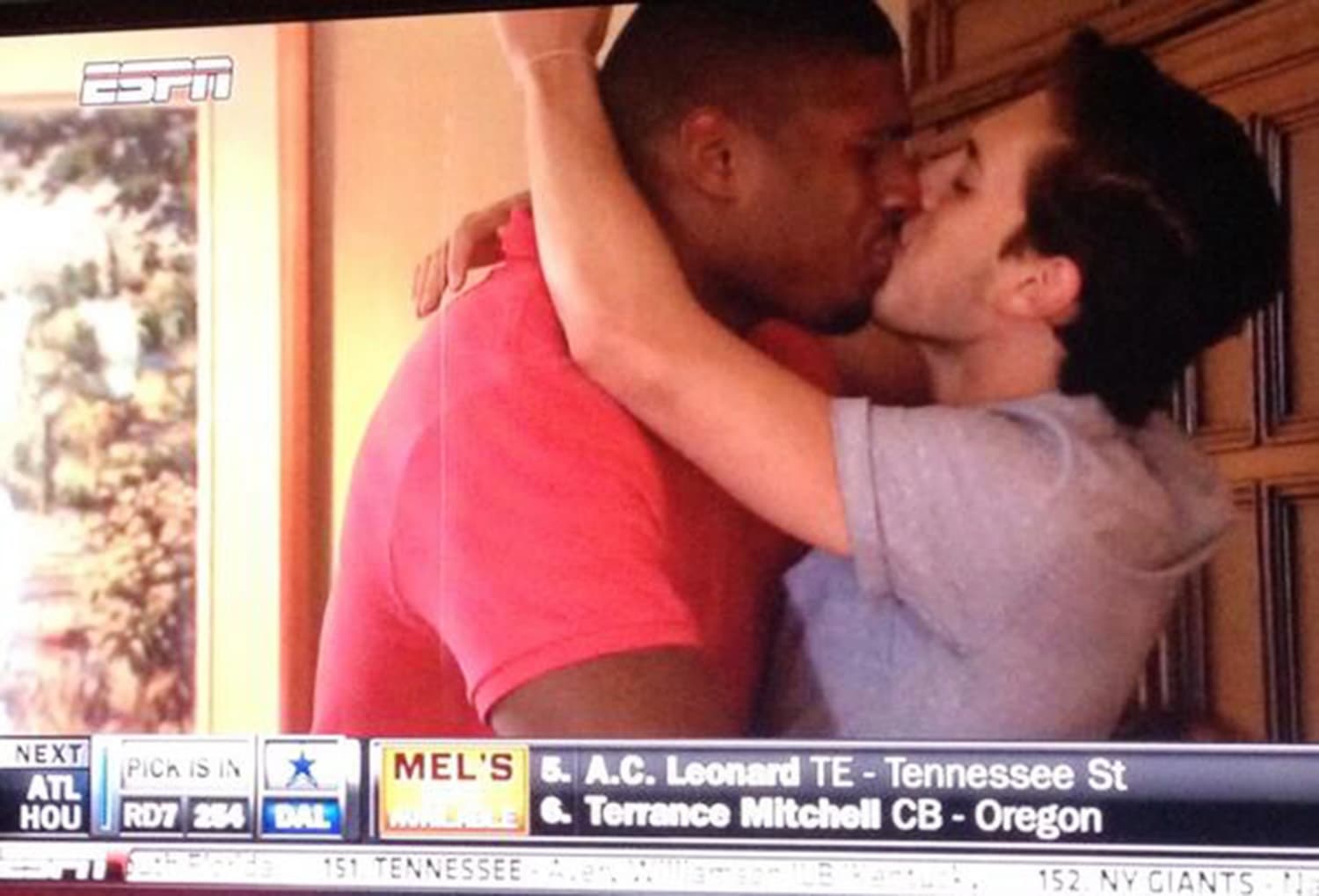
The title of this post comes from one of the complaints the FCC received in response to Michael Sam kissing his boyfriend after getting drafted into the NFL. I admit that I don’t particularly care about the NFL or about Michael Sam being added to the growing list of “first openly gay person to…” But I did find the language of the complaints to be really interesting. First, the repeated emphasis on display and “openness:”
“I was incensed at this vile, disgusting, inappropriate display of homosexual behaviour.” “The show depicted homosexual acts openly between two men”
This kind of talk stems less, I think, from a desire to pretend that homosexuality doesn’t exist, but rather from a different kind of sexual ethos that demands one speak around, rather than directly of, same-sex desires. In fact, second, the unwillingness to name what these viewers saw as “gay” — or even to use a pejorative — and instead the constant use of the term “homosexual” speaks, I think, to an attempt to name what is still essentially unnameable for a large segment of the population. For the most part, the complaints aren’t really about condemning same-sex desire as such — though that is clearly present — but rather about the fact that ESPN forced these viewers to engage with the existence of such desire on different terms. This is one reason why its important to not allow the national momentum seen by the gay marriage movement to overshadow continuing regional differences. Recently, the Human Rights Campaign announced a multimillion dollar program to promote gay rights in Arkansas, Mississippi, and Alabama. The goals of the campaign are rightly focused, it seems, on community outreach, but number one is “Empower LGBT people (and straight allies) to come out” and I wonder if that is necessarily the right path to take when it’s clear that the movement speaks an entirely different language than the people it is trying to reach.
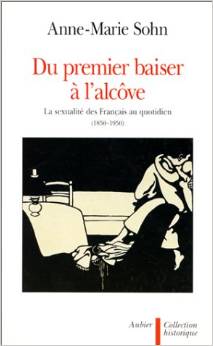
Anne Marie Sohn’s Du premier baiser a l’alcove (1996) argues that the movement towards sexual liberation began in the century prior to the “sexual revolution” of the 1960s.1 Explicitly contrasting her study against those that have focused on expert discourses on sexuality — a trend that she blames on the work of Michel Foucault — Sohn attempts to recuperate the sexual lives of “ordinary people.” Through an analysis of a dazzling amount of judicial records drawn from all over France, Sohn describes the sexual mores, practices, beliefs, and fears of both elite and popular classes.
However, the shear breadth of the material leads to two problems, one historical and the other theoretical. First, the evidence is presented without a great deal of context. While there are exceptions where Sohn effectively signposts moments of historical change, more often we are left wondering when exactly these various beliefs and practices went into and out of vogue. Second, the sheer volume of material leads her to a form of analysis through description. Rather than questioning the source material, she treats it largely as a transparent window onto historical truth.
The book therefore remains extraordinarily useful for researchers such as myself because of its documentation and narrative sweep. But it ultimately reifies the “repressive hypothesis” not simply through its argument that the Third Republic saw “a moral rupture which paves the way towards sexual liberation” [une rupture éthique qui ouvre la voie à la liberté sexuelle], but also through its unwillingness to complicate and situate its sources.2 Foucault’s lesson was not simply to pay attention to discourse, but to recognize the ways in which the “reality” that Sohn seeks to recover does not exist outside it.
1. Sohn, Anne-Marie. Du premier baiser à l’alcôve: La sexualité des Français au quotidien (1850-1950). Paris: Aubier, 1996↩
After what was a rather stressful and busy semester (year?), I’m hoping to get this site back into shape and hopefully post something now and then. Consider this a placeholder/promise of that goal.
The major assignment in my survey of Early Modern Europe this past semester required that students work in groups to construct guides to digital history on any topic within the period. Each guide was to comprise of an introduction to the topic using “traditional” research and a list and description of relevant online resources, databases, and/or projects. Those guides have been placed online via the course website and are available here. Topics ranged from the Reformation to French Colonialism to interactions between Western Europe and the Ottoman Empire. I chose to ask students to complete this assignment in this particular course after attending the Digital Humanities Summer School at the University of Bern, Switzerland this past summer where, among other things, I was introduced to the sheer volume of digital work being done on early modern material. My students’ guides, I think, give a fairly diverse entry point to the field; materials range from basic primary source databases to complex digital mapping projects.
Most of my work in the digital humanities has involved these kinds of assignments and they pose particular difficulties, especially in a survey course. First, students often have very little preexisting experience using web publishing platforms such as WordPress, programming or markup languages, or digital humanities more broadly. This means that class time must be devoted to introducing students to at least some of these areas in order for them to be able to complete the project. Second, topics that may be very prominent in the historiography — the Reformation, say — may not be as represented online. This creates a unique tension when helping students choose their topics; while we’d prefer to see digital work on topics of digital interest, students also need to be able to locate relevant analog sources as well. The guides themselves demonstrate this difficulty. While some feature a great deal of secondary source research in the introductions and much less by way of digital history work, others show the complete opposite. Third, grading projects that can — and should be — continually in progress poses problems not simply because of the time it takes in a survey course, but also because the projects are never really finished. Students continue to have access to their projects and can edit them freely; others can comment on them and offer advice and new resources can be added. I attempted to solve this problem by having two due dates: first, the initial draft had to be put online, then two weeks later I would download whatever was available online and grade that version (I used Evernote and Skitch to mark up the pages).
Digital history in the classroom, put simply, must be much more than just another assignment. Rather, it adds an entirely new layer of inquiry to any given course. In the future, I will probably devote even more in-class time to the assignment, a task made easier by the fact that almost everyday there is a new, relevant digital source available for us to work with. How would our reading of Candide have changed had I had the time to prepare to work with the Bibliothèque nationale’s Candide app? Perhaps it would be worth considering ways that the survey itself could turn more fully around the theme of the digital without losing the narrative such a course is designed to provide.
The semester is about to begin and I’ve uploaded websites and syllabi for the courses I’ll be teaching this semester, an advanced seminar on the French Revolution and a survey of Early Modern Europe.
At the risk of turning my blog into all Germany all the time, I wanted to put this up primarily as a teaching reference. Last semester, when my Modern Europe class had begun to study the Holocaust, Josh Marshall of Talking Points Memo put up a post on how he and his wife had to reassess what they knew of her family’s experience of the Holocaust. She had thought that her great-grandfather had been shot by the Einsatzgruppen, when in fact he had died in Auschwitz. This moment occurred just as I was re-reading Ruth Klüger’s Still Alive, in which she describes precisely the same realization that her “mental furniture has to be rearranged” because while she had thought her father had died in Auschwitz, he had in fact had been transported to Lithuania and Estonia and “who knows how they were murdered” (40). That “these stories have no end,” as Klüger says is aptly demonstrated by Marshall’s update to the story, in which he shows his readers his wife’s great-grandfather’s death certificate:
The reason I’m sharing this with you is that the death certificate itself captures for me one of the paradoxes of the Holocaust. Why even keep death certificates? Auschwitz was after all a network of concentration and extermination camps. I’m not even talking about the fear of possible punishment after the war, though that’s another significant question. Just simply, why? These are people, a whole people, being sent into oblivion, to be erased from the earth and from memory. These were to be much less than ordinary deaths.
A student of mine sends along a link to Cass Sustein’s thoughts on a recent paper that shows a link between high participation within the Nazi Party and strong civic associations in 1920s and early 1930s Germany. I’ve downloaded the article itself and hope to get the chance to read it, but I thought it worth offering a few quick thoughts on Sustein’s presentation of this argument, especially since I see that a number of people have talked about it. First, its worth noting that although historians obviously continue to debate the rise of the Nazis, many have noted the link between political and civic organizations and the rise of the Nazi Party. Second, the examples Sustein provides simply show that people talk to one another about their beliefs and sometimes change their minds. And yes, that may even occur among extremists.
Third, and most importantly, Sustein simply emphasizes the coexistence of associations and high Nazi Party membership without underscoring why such a connection may have existed in the first place. Correlation is not causation. Historian Peter Fritzsche, for instance, once argued that the associations that flourished in Weimar Germany failed in their attempt to create the kind of social links Germans were seeking after World War I. In fact, it was the Nazi Party itself that managed to represent a form of community more attractive to a significant amount of Germans. In other words, the correlation between civic associations and Nazi Party membership may be an inverse one; the places where people most frequently encountered the failed promise of community by these groups, the more likely they were to turn to another option: the Nazis.
It’s worth underlining just how good the Nazis were at this type of thing. The above image is a fairly well-known picture of Goebbels and Hitler having a “one-pot meal.” These were encouraged during the winters of the 1930s all the way through the war as a way of reducing waste and expense; the extra money a family saved by having one was supposed to go to charity. The image demonstrates just one way the party strove to incorporate itself within the everyday life of communities. Hitler himself changed his mode of presentation depending on the audience, and Nazis did set up charitable, paramilitary, and, most famously, youth organizations themselves that all served to incorporate the party more fully into certain communities. All this is to say that the simple existence of civic associations and social networks can, in no sense, be said to be enough to explain the rise of the Nazi Party. To find a more convincing explanation you have to learn to ask better historical questions: How did the Nazis take advantage of this phenomenon to facilitate their rise to power? It did not just happen by accident after all.
I’m fortunate to have received some funding for a research trip to Paris this summer and decided to spend my first weekend in town at a special exhibition at the Louvre, “On Germany,” which promised ” une réflexion autour des grands thèmes structurant la pensée allemande de 1800 à 1939.” The exposition proceeds chronologically and is divided into three parts: ““Apollo and Dionysius”, “Nature” and “Ecce Homo.” We move from the neoclassicism of the late Enlightenment into Romanticism and onward to the First World War (there’s a rather large gap in there, yes) and then conclude with artists I’m more familiar with, those such as Otto Dix, Käthe Kollwitz, and George Grosz, who wrestled with the implications of a post-total war modernity and the rise of the National Socialism. To my eye, the exposition constructed a narrative that progressed from an emergent German nationalism during the Napoleonic era to a counter discourse questioning the foundations of that ideology. If the exposition begins, in other words, with a survey of what would gradually become a dominant nationalist discourse, it ends with a counter-discourse that not only emphasized the failure of nationalism to create a coherent community, but also questioned whether German cultural nationalism could ever do so.
Otto Dix, Verwundeter (Herbst 1916, Bapaume) (1924)
A look online, however, revealed a different interpretation raging within the German press, who have accused the Louvre of reinscribing a teleological view of German history where the origins of the Nazis lay in the foundations of German nationalism. The Sonderweg, or special path of German history, moved from the cultural nationalism of Herder and Fichte to that of Hitler. As Adam Soboczynski put it in Die Zeit (translation into French is from Le Monde): “Que l’exposition s’achève avec la césure de 1939 ne doit rien au hasard. L’horreur est inscrite dans l’art allemand depuis Goethe. Les paysages nostalgiques d’Italie et de Grèce, la méditation sur le gothique, l’enthousiasme allemand pour le Moyen Age, l’accent mis sur la vie quotidienne, la dépréciation de la “profondeur” allemande ne sont, dans l’interprétation ainsi proposée, que des étapes qui mènent à la catastrophe allemande” (That the exhibition finishes with the turning point of 1939 was not by chance. Horror is inscribed on German art from Goethe on. The nostalgic landscapes of Italy and Greece, the meditation on the Gothic, the German enthusiasm for the Middle Ages, the emphasis put on everyday life, the depreciation of German “depth” are only, in the interpretation thus proposed, steps which lead to the German catastrophe). According to Soboczynski, simply arranging the chronology of the exhibition in a way that begins with the emergence of German nationalism and ends with World War II constitutes a reaffirmation of the Sonderweg. After all, the various themes of German art history that he points to would have been present under any circumstances; its thus the accent placed on them through the construction of chronology that enforces a narrative of inevitability onto German history.
I find it fascinating, however, that this particular critique points to the endpoint of 1939 as prima facie evidence that the organizers of the exhibition sought to enforce the Sonderweg. However, did the catastrophe not begin with Hitler’s rise to power in 1933? Does the choice to continue to the onset of World War II, while ignoring — with the exception of a short clip from Leni Riefenstahl’s Olympia (1938) — the dominant art of the period, that of the Nazis, not in fact deemphasize that aspect of German History? Why was there no mention of the Degenerate Art Exhibit, where one had to go in order to see the work of Dix and Grosz in the 1930s?
Artur Kampf, 30 Januar 1933
To speak of German art in the 1930s, one must speak of Nazi art because, like it or not, Nazi art was German Art. It seems to me, in other words, that the Louvre went out of its way to avoid the obvious narrative of German history. The exhibit instead contributed to an historical excision, indicating that the Nazis were simply an aberration and not wholly part of the German story. The exhibit presented a narrative that was essentially angular, not linear, by beginning with a dominant expression of German culture and ending with those expressions that were most thoroughly repressed at the very moment of their enunciation. That story would have been more convincing had they decided to end in 1933, when political power could be effectively exercised in a way that would mold German cultural expression into forms that corresponded with the virulent nationalism of the Nazis. The presence of Olympia, almost hidden within a middle room that stands within the very last part of the exhibition, indeed reveals the exhibitors own awareness of the problematic history they decided to present.
Such a narrative, however, too fails to truly avoid teleology. The more nuanced solution would have been to ask which Germany we’re referring to when we speak of “On Germany.” After all, Germany was only barely an idea at the beginning of the exhibition and only came into political existence in 1870. As Donald Lee says in The Art Newspaper, “The main problem with presenting art made in Germany (not including the Austrian Empire) between 1800 and 1939 (1933 would have made an historically more meaningful closure) is that it is very hard to create a coherent story that is made of so many disparate, divergent, contradictory, local, regional and confessional segments. It is a struggle to make the sum of the parts add up to a whole.” An attempt to acknowledge that complexity, a refusal to reduce the variety of German cultural expression into one “Germany” would have also highlighted the contingency of Germany itself. And in so doing, have revealed the contingency of the Nazis as well.
I’ve been fairly fascinated by the kerfluffle over the Heritage Foundation’s report on the implications of immigration reform not because the report itself was surprising in the conclusion it reached, but because of the way in which it (unfortunately?) reinvigorated a discussion on the relationship between IQ and race just after the doyen of such studies himself, Charles Murray, had visited Kenyon College. One of the co-authors of the report, it turns out, had written a Harvard dissertation asserting, among other things, that “No one knows whether Hispanics will ever reach IQ parity with whites, but the prediction that new Hispanic immigrants will have low-IQ children and grandchildren is difficult to argue against” and the U.S. should therefore institute an IQ-based selection system. I’ve been somewhat bemused by all this, not least because I was under the impression that the conclusion that low-IQ scores within certain racial groups can be attributed to genetic causes had been thoroughly discredited within the relevant social science literature (Andrew Sullivan’scontinued beating on the drum notwithstanding). Granted, as someone unconvinced that IQ measures anything biologically-fixed about a person whatsoever, I would not be inclined to give much credence to studies saying the opposite either. Ta-Nehisi Coates has a recent post on an alternative explanation for why such disparities come up when they do (and they often do).
Anyway, considering all this, I was fairly confused to see that Harvard approved a very recent (2009) dissertation making this kind of argument. There is a difference, it seems to me, between researchers at the American Enterprise Institute and those accredited by Harvard. So I was unsurprised to read that the author of the dissertation, Jason Richwine, thanks Charles Murray as his “primary advisor.” What continues to amaze me, and I thought it worth emphasizing this aspect of the story, was how Richwine came to the topic in the first place:
By his own account, Jason Richwine came to the Harvard Kennedy School deeply fascinated with the link between race and IQ. Richwine told The Washington Examiner’s Byron York that, as an undergraduate at American University, he fell in love with Charles Murray’s work on the topic. Murray, who will become an important player in Richwine’s story later on, is one of the authors of the infamous The Bell Curve, the 1994 book whose claims about the genetic roots of the black/white IQ gap set off the most famous public food fight over race and IQ. Richwine describes Murray as “my childhood hero.”
…
“Jason had the topic fully formed in his mind before he talked to me,” [the dissertation chair], wrote via email. “I played no role in topic selection or forming the research agenda.”This line raised eyebrows among some scholars familiar with social science dissertations. Dan Drezner is a Professor of International Politics at Tufts’ Fletcher School, an institution that’s somewhat similar to Harvard’s Kennedy School in character, who’s been following the Richwine case closely. “If I’m an advisor, and I have a student that comes to me,” Drezner said, “the last thing I would do is say ‘write this.’” They key issue is “how well formed was Richwine’s argument when he came to Borjas?” Students should come up with their own dissertation topics, Drezner said, but if an advisor didn’t sufficiently challenge them on whether it was a good, well-thought out program, that could be a problem.
Everyone who enteres a research project comes into it with certain predispositions and predilections. Otherwise, they probably wouldn’t be that interested in doing the research the first place. But anyone who enters a dissertation with an idea of a project (and apparently, in this case, an answer as well!) and comes out of it with the exact same idea, probably has a problem that goes beyond the lack of a primary advisor willing to challenge your assumptions. Sometimes you just begin a project that is not feasible as a grad student. Sometimes the materials don’t exist or the research would be too expensive. Sometimes the results come out differently than you expect or the evidence doesn’t support your initial claim or idea. But always, always, you engage with a pre-existing literature that will inevitably reshape the contours of a topic that you initially formulated prior to graduate school. There is a vast difference between working on IQ in 1994 and working on it in 2004. The Belle Curve itself actually has little to do with this issue; a research topic that does not shift through a four year (in Richline’s case) dissertation is one that has not developed sufficiently for doctoral research.
Indeed, this is something I emphasize to my students in “Practice and Theory of History.” We begin that course with a research proposal and the one thing I emphasize as we begin to work on it is that the final project will often not resemble the argument and topic initially posed. Most of my students, with some resistance, came around to seeing why that might be the case and why, in the end, that is a good thing. It signifies their ability to master even a small part of a literature and to understand the ways in which scholarship transforms and shifts over time in reaction to the work a community of scholars engages in together. Richwine, it seems, failed to understand that very basic concept.
I use the iOS app GradeBook Pro to take attendance and keep track of grades through the course of the semester. I was pleased, therefore, to see two new features appear after I upgraded to the latest version: letter grade assignments and behavior tracking. The first simply allows you to assign letter grades to percentage scores by recording the lowest valid numerical score per letter grade (so, 93% as A, 90% as A-, 88% as B+, etc). It’s also extremely easy to copy grade scales from courses, which means you really only have to input the scale once.
The second new feature allows you to quickly note student “behavior” (read: participation) in class. In small seminars, I tend to take notes and am able to assess student participation fairly consistently. In larger classes, where I still ask students questions and hold discussions, but which also tend to go a bit faster and involve more students participating (and more students not participating), this will be a useful tool for quickly noting who has and has not participated.
The screenshot shows the default labels for behavior. They can be customized in the GradeBook Pro tab of the iOS settings app.
GradeBookPro can be downloaded from the iTunes store for $9.99.
 (1996) argues that the movement towards sexual liberation began in the century prior to the “sexual revolution” of the 1960s.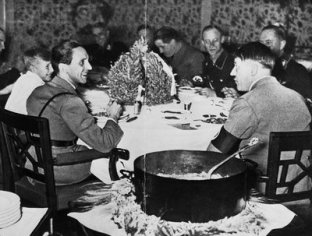

![image: Otto Dix 'Verwundeter (Herbst 1916, Bapaume) [Wounded soldier - Autumn 1916, Bapaume]' etching, aquatint, Collection of the National Gallery of Australia, The Poynton Bequest 2003](https://cs.nga.gov.au/IMAGES/MED/128588.JPG)