AI in the History Classroom

I am very much on record of being extremely tired having the same discussion about AI over and over again. Over and over again, colleagues both on my campus and more broadly express deep anxiety, frustration, and anger about the ways that “AI” has been deployed by various tech companies and disappointment in students who have taken to it both innocently and for less appropriate reasons. All of which I share. Indeed, I have noted with increasing dismay how difficult students find reading and understanding relatively short texts, a problem exacerbated (though almost certainly not simply caused by) the use of AI to summarize for them. However, these conversations almost always remain just gripe sessions, ending without any real solutions or advice about what to do in the classroom. My own policy, thus far, has been to ban its use, clearly explain why I am doing so (in short: the goal of a history class is to learn to think and write on one’s own), and sometimes devote some class time to discussing it. I am 100% that such bans have not been entirely effective, though I do think that by taking time out of class to talk about it and explain my reasoning has been successful in lessening its more nefarious uses. That said, it is obvious to everyone reading about AI in higher education to anyone in the classroom that students are using it all the time and I am somewhat at a loss as to what to do about it.

So I had a bit of a different response than a lot of people to the recent publication of “Guiding Principles for Artificial Intelligence in History Education” from the American Historical Association. Most people in Bluesky dismissed it outright, as accepting what should not be accepted in the first place: that AI is here to stay (I’ll note here that I hate referring to ChatGPT and tools of its kind as “AI,” which it is not, but that seems to be the terminology). On the other hand, I’ve seen a few responses lamenting that so many historians are dismissing AI out of hand, especially its possible uses in research (this I saw on a private forum of AHA members, so no link). I think both miss what the document is trying to address: what should educators, some of whom are going to be entering the classroom in two weeks, actually do about these tools now and as they exist in the world and are being used by our students? What practical advice might be helpful for instructors developing syllabi right now? Taken on those terms, I find its advice somewhat helpful, if occasionally less clear than it might be. It ends with a serious “wtf?” So some thoughts. (I also, as an aside, wish folks commenting on these kinds of documents would remember that they were produced by their colleagues who, I try to believe, deserve grace and the assumption that they are not shills for tech companies).

First, I read the document as premised on different assumptions than those animating AI-boosters in both tech and higher education. The recent Microsoft-produced list of professions most likely to be replaced by AI laughably included “historian” near the top, which of course simply means that whomever (or whatever) made the list doesn’t know what a historian actually does. As the “Guiding Principles” explains, “Generative AI tools risk promoting an illusion that the past is fully knowable.” The Microsoft list speaks to a more broadly shared misunderstanding about what historians actually do. Historians seek out new knowledge, interpretations, sources, and ideas; they do not simply recreate (as generative AI does) what is already there. The past does not exist independently of our interpretation of it, ready for us to simply discover. My department — prior to the advent of generative AI — redesigned our introductory history course to focus on precisely this point: teaching students that history is an interpretative discipline. Doing so, one might hope, will show the deep limitations of AI in doing the work of history.

When addressing some of these limitations, however, I wish that the “Guiding Principles” had been more forceful. Having read — and taught — a recent article describing AI “hallucinations” as “bullshit” it is worth asking whether it is worth using AI when it has a significant chance of doing so rather than “work[ing] to counter these hallucinations when they appear.” Rather, it seems to me, that AI tools might be best suited to use cases with a clear, user-defined dataset and/or for purposes of refinement and formatting rather than search and/or text generation. In my own life, I admit that I have found generative AI useful in making a schedule of habits and tasks that I had some trouble getting my head around and in planning a road trip, both of which involved me feeding it the data and it then working through a problem that would have taken me a great deal of time. Any tool that bullshits its results does not seem suited for the kinds of tasks we set ourselves or our students in our professional lives.

Third, I am sympathetic to why the “Guiding Principles” declare that “Banning generative AI is not a long-term solution” even as it has been my own solution thus far. On Bluesky, I’ve seen a number of comments arguing that the AHA has betrayed historians, with people saying that they’d blackball any researcher who submitted anything written with the help of AI, and that we should hold the line. A lot of this, I think, comes from a place of true distress at how tech companies have, without our consent, fundamentally changed our relationship to the internet, to research, to writing, and, most importantly, to our students. But I do not think, based on what I have read and seen, it is realistic to hope that this is simply going to go away or that the AHA is in a position to stop its spread. I agree that we should have clear standards about the use of AI in research (and I agree that no-one should be using it to write their articles), but that was not the purpose of this document. The tools are out there and basically every single one of our students is already using it. 

Screen shot of a table from the "Guiding Principles" discussed in the post
Screenshot

In that sense, finally, I am both annoyed and gratified by the practical advice the the “Guiding Principles” provides regarding the need for “concrete and transparent policies.” Breaking down the various ways that students are using these tools in the Appendix helped me better understand some of the questions I need to ask about my assignments and how I will approach AI conversations in the classroom. Indeed, while I do not think my policies will be changing have read the document — I still find the use of generative AI to be counter to the goals of my courses — I do think I can better answer students when they inevitably ask about specific use cases. For instance, I actually do not mind if a student uses AI to help them format a footnote. I already allow them to use (and use myself) citation managers and I see little difference in transferring that work (especially for a short paper) to a different tool. I appreciate being prodded to think clearly about the various ways that students are going to use these tools so that I can formulate a response and a policy in advance.

What concerns me, and I think this is where the Committee needed to really rethink their approach (my “wtf?” moment), is that the document does not just provide a sample template for an AI policy, but also provides one that is already filled out. I do not think this was the intent of the Committee, but it reads as recommendations for an AI policy, rather than an example of a completed syllabus policy. And so, when readers come across an AHA-branded document that claims that it is acceptable to “ask generative AI to identify or summarize key points in an article before you read it,” people are rightfully alarmed. One of the points of a history class is to read the article. Even worse is suggesting that it is ok for students to generate a historical image, which seems wildly inappropriate even if the student cites such use. Such language has been circulating on social media and is shaping how people are responding to the document as a whole.

I, by and large, hate these tools. I hate how Google is basically unusable now. I hate how tech bros think they know better than those with expertise. I hate how these companies have reshaped our world without our consent. I hate how the actual use cases for these tools seem much more narrow than people think. I hate how the widespread use of these tools is going to lead to a much dumber world, where new ideas have much more difficulty getting out there. But I also don’t think I’m in a position to stop it. Instead, we need new strategies to get students (to say nothing of the broader public) to value the purpose of learning itself, to get excited about the process, and to recognize the importance of the skills that AI-boosters claim (read: lie about) will be replaced. I am doubtful that the AI bubble is going to just burst, as I see some people claim on social media. I hope I am wrong, but am planning for being right.
“Use of History” Assignment

I just revised my teaching page, simplifying it and adding some new resources. One of the assignments I included was a new one, which I called — for lack of a better name — a “Use of History” Essay. The assignment asked students in my introductory, general education Modern Europe survey to choose a news article or opinion piece from a mainstream magazine or newspaper and evaluate the ways it used history. I was impressed by the quality of the work even though I was concerned that I had not done enough to prepare them for the task. It’s relative success means that I might be on to something and with some greater scaffolding and revision have a nice way of introducing some more advanced concepts into this course.

Continue reading ““Use of History” Assignment”

Digital History and Early Modern Europe

The major assignment in my survey of Early Modern Europe this past semester required that students work in groups to construct guides to digital history on any topic within the period. Each guide was to comprise of an introduction to the topic using “traditional” research and a list and description of relevant online resources, databases, and/or projects. Those guides have been placed online via the course website and are available here. Topics ranged from the Reformation to French Colonialism to interactions between Western Europe and the Ottoman Empire. I chose to ask students to complete this assignment in this particular course after attending the Digital Humanities Summer School at the University of Bern, Switzerland this past summer where, among other things, I was introduced to the sheer volume of digital work being done on early modern material. My students’ guides, I think, give a fairly diverse entry point to the field; materials range from basic primary source databases to complex digital mapping projects.

Most of my work in the digital humanities has involved these kinds of assignments and they pose particular difficulties, especially in a survey course. First, students often have very little preexisting experience using web publishing platforms such as WordPress, programming or markup languages, or digital humanities more broadly. This means that class time must be devoted to introducing students to at least some of these areas in order for them to be able to complete the project. Second, topics that may be very prominent in the historiography — the Reformation, say — may not be as represented online. This creates a unique tension when helping students choose their topics; while we’d prefer to see digital work on topics of digital interest, students also need to be able to locate relevant analog sources as well. The guides themselves demonstrate this difficulty. While some feature a great deal of secondary source research in the introductions and much less by way of digital history work, others show the complete opposite. Third, grading projects that can — and should be — continually in progress poses problems not simply because of the time it takes in a survey course, but also because the projects are never really finished. Students continue to have access to their projects and can edit them freely; others can comment on them and offer advice and new resources can be added. I attempted to solve this problem by having two due dates: first, the initial draft had to be put online, then two weeks later I would download whatever was available online and grade that version (I used Evernote and Skitch to mark up the pages).

Digital history in the classroom, put simply, must be much more than just another assignment. Rather, it adds an entirely new layer of inquiry to any given course. In the future, I will probably devote even more in-class time to the assignment, a task made easier by the fact that almost everyday there is a new, relevant digital source available for us to work with. How would our reading of Candide have changed had I had the time to prepare to work with the Bibliothèque nationale’s Candide app? Perhaps it would be worth considering ways that the survey itself could turn more fully around the theme of the digital without losing the narrative such a course is designed to provide.

New GradeBook Pro Features

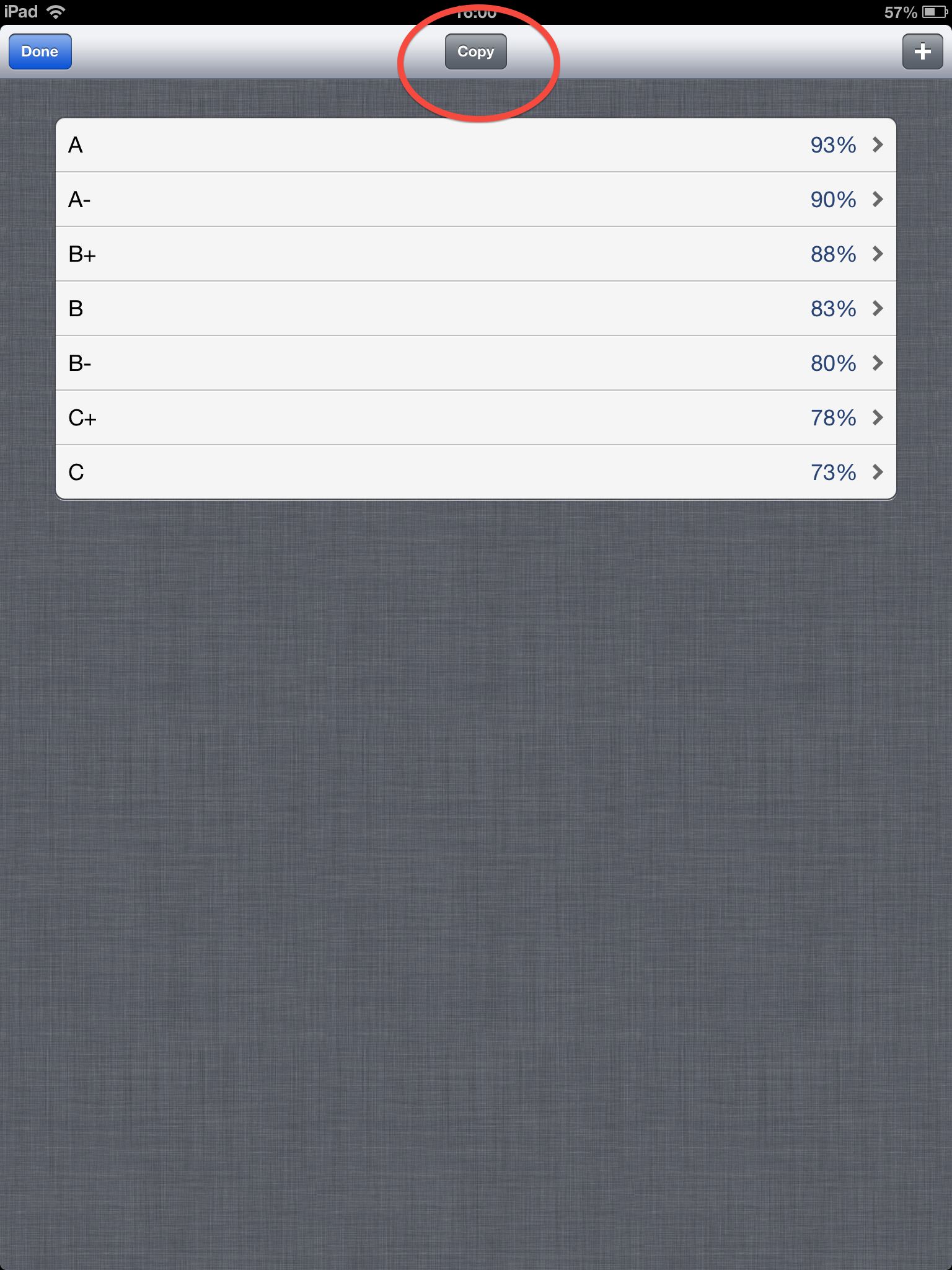
I use the iOS app GradeBook Pro to take attendance and keep track of grades through the course of the semester. I was pleased, therefore, to see two new features appear after I upgraded to the latest version: letter grade assignments and behavior tracking.  The first simply allows you to assign letter grades to percentage scores by recording the lowest valid numerical score per letter grade (so, 93% as A, 90% as A-, 88% as B+, etc).  It’s also extremely easy to copy grade scales from courses, which means you really only have to input the scale once.

IMG_0261

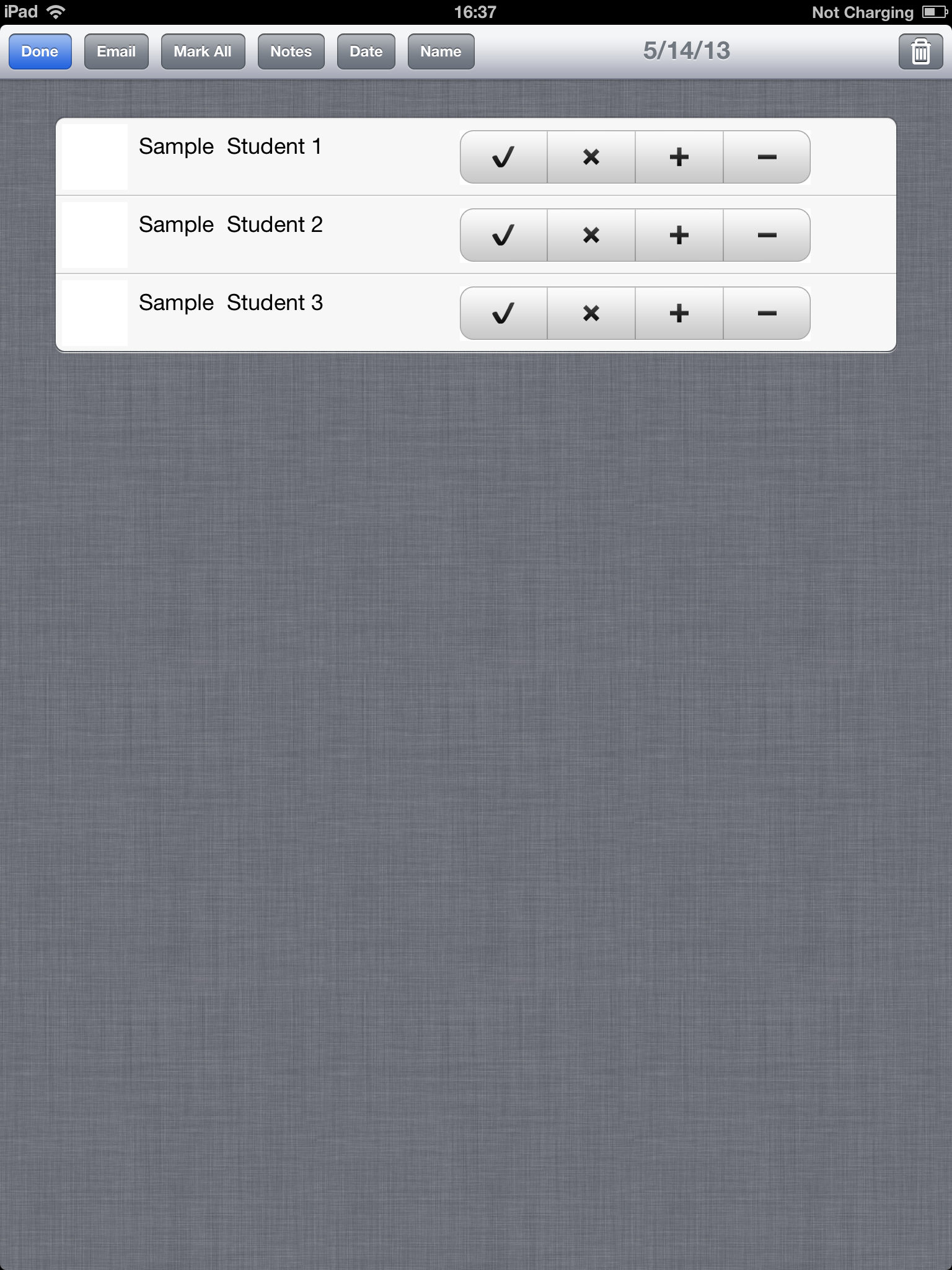
The second new feature allows you to quickly note student “behavior” (read: participation) in class.  In small seminars, I tend to take notes and am able to assess student participation fairly consistently.  In larger classes, where I still ask students questions and hold discussions, but which also tend to go a bit faster and involve more students participating (and more students not participating), this will be a useful tool for quickly noting who has and has not participated.

IMG_0263

The screenshot shows the default labels for behavior.  They can be customized in the GradeBook Pro tab of the iOS settings app.

GradeBookPro can be downloaded from the iTunes store for $9.99.

Mary Louise Roberts on Entering the Digital Age

One of my favorite historians discusses her newfound enthusiasm for utilizing forms of social media in the classroom:

Somewhere along the way, I realized this is how they learn—this juxtaposition and making of connections, this linking of yesterday and today. What the technologies of the digital age have done for my classroom is to let in the outside world in new and valuable ways, so that more than ever the past is viewed through the lens of the present. This strikes me as a brilliant way to do our work and to make history matter in students’ lives.

History of Sexuality Lecture

I just delivered a guest lecture/seminar to a class called “Body Politics.”  It was essentially an introduction to the history of sexuality, Foucault, and early sexology with an eye towards the week’s reading by Joanne Meyerowitz from her fantastic book, How Sex Changed.  The powerpoint for the lecture can now be accessed for students and other interested parties.

Teaching Carnival

Profhacker is hosting a new teaching carnival, with useful links for teachers and students alike.

Use Scrible to Grade Web Based Assignments

I wish I had known about this when one of my classes was putting up their Wikipedia pages this semester, but in the course of searching for a better way of grading my blogging assignment for Modern Europe, I came across a nifty tool called Scrible.  Scrible allows you to annotate webpages without converting them to a clunky pdf version (I tried to do this using Adobe Acrobat Pro and the resulting file was just huge).  Basic annotation tools — notes, highlights, you can even change the text formatting — are all I need for grading, though the alignment between a note and its relevant text on the page could use some work.  Scrible is in beta and comes with a free library of 125 MB for storing marked up pages, which is perfect for saving graded blogs to e-mail to students once they’re all done (which you can do straight from the Scrible toolbar).  For any more research-oriented needs, Instapaper (for ease of access on the go) and Evernote (for keeping everything in one place) are clearly better solutions, but for this particular purpose it’s everything I could ask for.

Lessons of the Holocaust

Two of my courses are in the midst of World War II, a moment I mostly hate teaching, but will almost certainly find myself doing so for the rest of my life. I hate teaching it not simply because of the morbid fascination it always seems to evoke in people — and certainly not just in undergraduates — but because it’s so often cited as the reason to study history in the first place. Learn from the past, so we never repeat it. The Holocaust has come to stand in for the lessons of the past as a whole.

This conviction, propagated by memorials and memoirs, is one I try to challenge as I lecture and as we talk about the Holocaust. And it’s why I’ve assigned Ruth Kluger’s absolutely brutal Still Alive: A Holocaust Girlhood Remembered (2001), rather than, say, Primo Levi’s Survival in Auschwitz. Her account refuses to shy away from what the Holocaust actually was: a time of degradation, if in its most modern form. It tore people apart and rarely brought them together. Those who survived often did despite the failures of their neighbors and family, rather than through their righteous support:

When I tell people…that I feel no compunction about citing examples of my mother’s petty cruelties towards me, my hearers act surprised, assume a stance of virtuous indignation, and tell me that, given the hardships we had to endure during the Hitler period, the victims should have come closer together and formed strong bonds. Particularly young people should have done so, say the elderly. But this is sentimental rubbish and depends on a false concept of suffering as a source of moral education (52).

I hate teaching the Holocaust because every time I return to this beautifully, scandalously, brutal book, I can’t help but agree. Primo Levi depicted Auschwitz as a giant laboratory in which one could see how men and women functioned when placed in the most dire of situations. In doing so, he assumes that there is something, however, horrible to learn there. Kluger implies, as Lore Segal’s wonderful introduction notes, that in fact Levi “died of his knowledge” (10). I don’t think that the student of the Holocaust should come away with a newfound appreciation of the resiliency of the human spirit because doing so simply fits the event into a preconceived narrative that allows us to forget what the Holocaust actually was. Instead, the study of the Holocaust is an opportunity to question received ideas and ask whether we’ve been listening effectively to the voices of the past in the first place.

Blogging History

My Modern Europe students begin blogging history using historical newspapers and periodicals today. A list of topics and links to their pseudonymous blogs can be found here: http://aiross.wordpress.com/teaching/modern-europe-winter-2012/modern-europe-winter-2012-student-blogs/.